
The textile industry, one of the oldest in human history. Specific history states that the oldest known fabric dates back to before 5000 B.C. Essentially, for textile manufacturing, the main requirement is to have a fiber source from which a type of thread can be developed.
The thread is processed through weaving or braiding, which turns the finest thread into woven fabric. Now, the machine used for interlacing is the well-known loom; likewise, for decorating these fabrics, the process of adding color to the thread or finishing the material is dyeing.
The art of tailoring involves shaping different tastes and needs of people into clothing pieces for various occasions that express their character and personality in many unique ways. That is, garment tailoring is not only limited to fulfilling a specific utilitarian function but also to being aesthetically unique.
Clothing
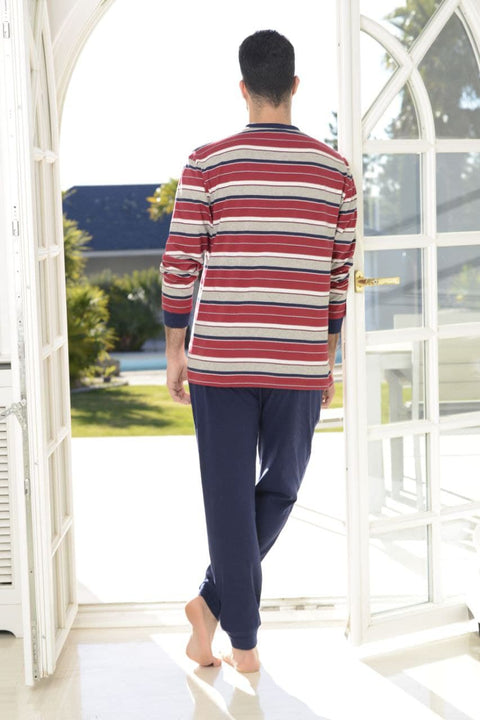
Thus, we have garments for day to night, clothes for work, meetings with friends or family, going to the gym or walking, and for nighttime rest, pajamas. All garments designed for specific purposes and with special characteristics that make them fulfill the function for which they were designed.
But tailoring also involves the ideal woven fabric so that the authentic garment is truly perfect. Today, there are types of fibers widely used in the industry, such as natural fibers of plant origin like cotton, linen, bamboo, jute, and hemp, and animal or protein-based fibers such as wool, silk, and angora.
These fibers have been used for centuries in the creation, design, and production of all kinds of garments including pajamas for ladies, gentlemen, and children. But also, there are fibers made by humans, that is, artificially produced from natural raw materials, such as rayon, acetate, modal, cupro, and the recently developed lyocell.
Additionally, the industry currently develops a series of synthetic fibers, a classification of man-made fibers, which specifically come from synthetic chemical elements as a base instead of natural chemicals.
Variety of Woven Fabrics
Today, there are many varieties of woven fabrics for making garments for all uses. Thanks to technological evolution, it is possible to continue developing various types of woven fabrics mainly used in fashion with two objectives: on one hand, to improve the quality and characteristics of different garments such as comfort, durability, functionality, and other important tailoring attributes; on the other hand, the social commitment to protect the environment during the tailoring process.
In recent years, many brands have made great progress in these two areas. Among the most common woven fabrics, cotton is ideal for very comfortable and commercial pajamas, as cotton is the most common and popular woven fabric since it is a natural fiber with natural shine and a warm, soft touch. It is also quite durable, absorbs moisture perfectly, and retains body heat well.
Another textile that sells very well is elastane, which as a synthetic fiber blends very well with cotton and provides great elasticity. You can find pajamas on the market with more than 90% cotton and a minimal percentage of elastane, ensuring enough elasticity for the garment to fit the body perfectly and allow greater mobility without deforming the garment.
Now, organic cotton essentially has the same properties as non-organic cotton fibers; the difference lies mainly in its color, the production process, and the strict environmental limitations during its handling and treatment. Organic cotton is grown without synthetic additives or pesticides and is not genetically modified, making it sustainable and environmentally friendly.
Eco-Friendly Textiles
Within this important idea of social responsibility, we also have Tencel, a brand of regenerated fibers made from wood pulp to produce cellulose-based fibers. This fiber uses renewable raw materials from sustainable forests where felled trees are replanted, a policy that aims for high resource efficiency and minimal ecological impact.
Likewise, the production processes of this fiber are much more efficient and sustainable. This results in better properties of touch, absorption, color, and shine.
There are two main groups of Tencel fibers: Tencel Modal and Tencel Lyocell. The difference between these two groups lies in the production process, format, and some intrinsic properties. Both are very fine fibers with a soft touch, good mechanical strength, and elastic recovery. They also have greater adaptability and better drape. Both have a soft, cool, silky feel, high absorption, good color retention, and shine. Additionally, they have very low static electricity.
Other Fibers and Textiles
In this search for versatile fibers, we have polyamide, a synthetic fiber with high wear resistance, providing greater durability and high elastic recovery, meaning a great ability to maintain its shape, offering garments that do not deform with use.
It also dries quickly due to very low absorption, is easy to handle and treat after use, and is highly resistant to microorganisms; hence, polyamide microfiber significantly improves touch properties and facilitates moisture and temperature management.
But if we consider more traditional fibers, polyester is a synthetic fiber with high resistance to breakage and friction wear. It also has high elasticity and quick drying, making it very easy to handle and treat after use. It is a thermal insulating fiber and basically very resistant to microorganisms.
It is very important to know these textile options because when choosing pajamas, it is possible to understand not only the garment’s properties in use but also the care needed for its preservation. Undoubtedly, today the textile industry makes great efforts to provide the best quality textiles for manufacturing highly durable garments that are not only attractive in design.
Garment design, especially for nighttime rest, must involve comfort, durability, hygiene, and aesthetics. Visit our website El Búho Nocturno where you will find numerous collections of pajamas that you will surely love.