
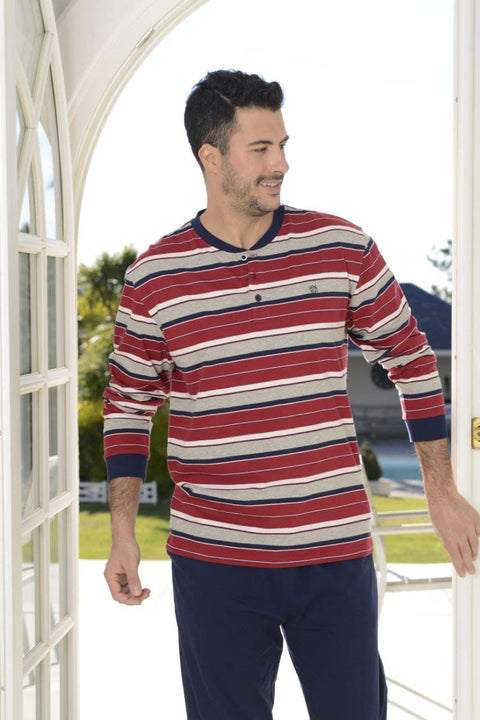
The Pajamas and the Designers
The Evolution of Men's Pajamas
Boxers and a shirt, this is how most men have dressed for bed since they gave up childhood football pajamas. Occasionally, if it’s cold enough, a pair of fine cotton pants might be worn.
The Current Preference of Young People
From what can be said, it seems to be the same behavior among all the younger generation today: an old shirt combined with a pair of shorts or pants. A 2004 survey by ABC News found that only 13 percent of men wore pajamas, with a clear downward trend. So, the question must be asked: What happened to pajamas? What is known about those formal two-piece suits that evoke images of Dick Van Dyke or Desi Arnaz?
The Persistence of Pajamas
According to design historians, pajamas are definitely not dead. Somewhere, right now, high-end pajama sets must be selling to someone. There are even some more affordable versions, but whether men today wear them is another matter. According to a study by the pajama company Sleep Jones, only half of their customers wear their pajamas to bed.
Pajamas as a Fashion Statement
"Pajamas are more of a fashion statement now,” note fashion and design historians at The New School. They add that pajamas are still part of what is considered "a gentleman’s wardrobe," and explain that these garments are more likely to be found in the closets of the upper class, while average middle-class youth simply opt for boxers and a shirt.
History of Pajamas
Origins in India
Originally, pajamas, or pyjamas as they are spelled outside the United States, came from Indian fashion. During the days of the British Empire, colonists noticed these lightweight drawstring pants and thought they looked very nice, so they brought them back to England with them. Soon, among the upper class, pajamas would be paired with a matching jacket to replace the nightgown.
The Nightshirt
Before pajamas, men and women essentially wore the same thing to bed. This outfit was a long shirt that extended almost to the floor. For the lower classes, the shirt might have been a bit shorter, as it could well have been the same shirt they worked in during the day.
The Popularization of Pajamas
The Pajama and Dressing Gown Set
Soon, these novel pajamas would be combined with the preexisting dressing gown, better known as a bathrobe. This set became the popular garment among the wealthy when visiting close family or friends at home. They were made of beautiful fabrics and had intricate designs, becoming a status symbol throughout Europe and America.
The 20th Century and the Evolution of Pajamas
For the lower class, the nightshirt would persist as the main sleepwear until some decades into the 20th century, as it remained the warmest way to dress in a house before central heating. With a high collar, wide sleeves, and mid-calf or longer length, the nightshirt was warmer than a two-piece pajama. It would not be until the 1920s that pajamas began to make their way into the mainstream.
The 1950s
In the 1950s, stylish pajamas were being replaced by more comfortable and casual styles made of elastic knit fabrics on top and fine cotton cloth pants. Basically, with cheaper fabrics came greater accessibility, and by the 1950s, the nightshirt had long been dead.
The 70s and 80s
In the 1970s, however, things changed. There was a resurgence of grandfather-style nightshirts and pajama sets with shiny satin dressing gowns. This decade also saw the birth of multi-purpose clothing during the disco era, with clothes that could be worn at work and at the disco. Soon sportswear emerged, where gym clothes began to be worn in public, especially during the 1980s and beyond.
The Breaking of Dress Rules
Along with this break in dress rules, the pajama set became a victim. During the 1950s and 1960s, a working-class man could come home and fall into a routine similar to that of an aristocrat, where he took off his suit and put on a sweater before changing once more to go to bed. However, as life’s pace quickened, the popularity of pajamas eroded. From the 1970s and 1980s onward, men were more likely to come home and put on a pair of sweatpants or shorts. There wasn’t much reason to change again after that.
The Designers’ Opinion
The Rise of Democracy in Fashion
While some may see this as a break from norms, design experts point out that a sexier way to say it is that it reflects the rise of democracy. As conversion to a more open society increases and class walls come down, pomp and formality go with it. Examples include billionaires like Steve Jobs and Mark Zuckerberg, who you would never know were rich if you didn’t know their faces.
The Return of Elegance
Perhaps, then, in an era when many believe democracy is eroding, could pajamas return? Well, maybe. Nowadays, there is something the fashion industry calls the “return of elegance,” where formality is coming back. For years, men’s fashion runways have been dominated by men in hoodies and sweatpants, but as an antidote to that, some designers have gone the other way. There’s nothing more you can do with sweatpants. Perhaps the pendulum will swing the other way and more formal attire will return.
So, while our future may soon look like an Orwellian nightmare, at least we can have a nice pajama to try to sleep in.
To discover more about pajamas and sleepwear fashion, visit our store El Búho Nocturno.