
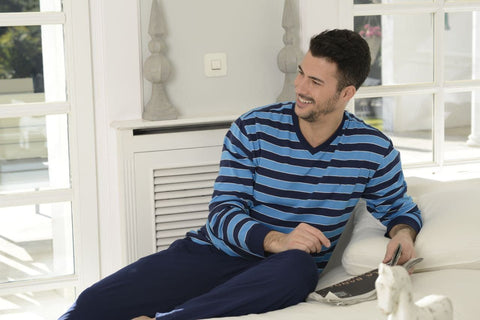
How and why did the transformation occur from wearing basic tunics or underwear as sleepwear to specific fashion sleepwear?
For most of Western history, life was very hard and people had very limited wardrobes. Most people wore a linen shirt (women) or a shirt (men) as their main undergarment, which often doubled as sleepwear. However, during the Renaissance, it began to be observed that the very wealthy started to have separate sleepwear, very similar to the shirt.
From the late Renaissance to the Baroque period, more relaxed garments were also incorporated into homewear; today, these types of garments are known as loungewear. These garments included short jackets (which could be knit) and a relaxed tunic worn by men called a banyan. Women adopted the dressing gown as a common item during the Baroque period. These lounge garments would be modified over the centuries (becoming dressing gowns, tuxedos, formal capes, etc.) but served the same purpose.
There was a much greater emphasis on proper attire during the 19th century. Garments became much more affordable as a result of the Industrial Revolution (which also resulted in a shift from linen to cotton) and proper attire was a way to establish status. It is believed that pajamas were introduced into Western clothing by British colonists who had adopted them while living in India. Nightgowns became increasingly associated with tradition, while pajamas were promoted as sensible, modern, and suitable for an active lifestyle. They became quite common after 1900.
Evolution of Pajamas by Gender
Women began adopting pajamas in the 1910s, when pan-Orientalism was in fashion, and it peaked during the 1920s. Since then, men's pajamas have remained fairly consistent, while women's have followed fashion changes.
Women's nightgowns followed a similar trajectory during the 19th century. After the 1870s, nightgowns and accompanying tunics became increasingly elaborate and tied to fashion trends. Materials became finer and more delicate, and color was introduced. Nightgowns followed the fashion lines of clothing: examples from the 1920s are geometric and tubular, those from the 1930s are sinuous and bias-cut. Modern materials like rayon and nylon were widely used and made elaborate creations with ruffles more affordable and practical than ever.
Traditionally, women were expected to have a sleepwear wardrobe as an extension of their daily clothing. Women's sleepwear is more subject to fashion whims and, therefore, women buy more. In museum collections, women's nightgowns abound, while men's pajamas are hard to find because men tend to wear the same thing repeatedly until it wears out.
Nowadays, it is not very common for the average man to be aware of the consequences of not frequently wearing sleepwear; to the point of concluding that this fact could have influenced suffering long nights of poor sleep, even insomnia. It is also unlikely that once frequent use of pajamas as a “rest and relaxation uniform” is tried, one would ever give it up.
Many people really do not consider the importance of sleepwear. If you think about it this way: just as you have work clothes for the professional environment and clothes you would wear for a party night or special gala, sleep time also demands a specific dress code. Which inherently comes with many unexpected benefits included. One day you will simply notice that by adhering to this code, the nighttime stay in bed will be more than comforting, and for very good reasons that will tangibly and definitively transcend into the user's overall well-being.
Men's sleepwear ranges from pajamas to boxers, jackets, loose t-shirts, and relaxed pants. While style variations are amplified by design choices, emphasis is always placed on comfort and the feeling of confidence the garment produces on the wearer, which tends to remain constant when choosing the right material and combination.
There is also a bit of history of sleepwear linked to men's clothing such as pajamas.
With so many people confined at home these past months due to the global health emergency, the interior of homes has become the new exterior for many. It is where exercise is done, digital chats with friends happen, and, of course, remote work is carried out. But it also remains the interior where people sleep, rest, and perform all the activities essential to the daily life of the average person. This can lead to frequent wardrobe changes and, of course, a reconsideration of the men's wardrobe.
The need for sleepwear, specifically pajamas as part of the male wardrobe, is more than a piece of history attributed to necessity and modernity. It extends to that very private comfort and allows a kind of relationship between the senses and different states of relaxation, reaching a true development of a healthy mental state for anyone. It is comfort at its maximum expression, as the material of sleepwear or pajamas is looser and does not cling to the body, granting a true state of freedom. This allows sleeping without inhibitions and ensures that blood circulation remains optimal and unobstructed during sleep.
Although recently, pajamas have become a style of outerwear and everyday wear for many people, it should be known that the materials used to make these designs for different occasions and functions are also diverse. Therefore, sleepwear should not be confused with daily and casual wear. This daily wear for being at home could be a pair of worn shirts and pants, excessively used at home; which could be a variety of combinations and to which a loose and slow approach to life can be added for a more relaxed lifestyle.
The need for style in sleepwear cannot be underestimated, just as effort is put into selecting usual clothing, pajamas should also be considered among these important decisions.