
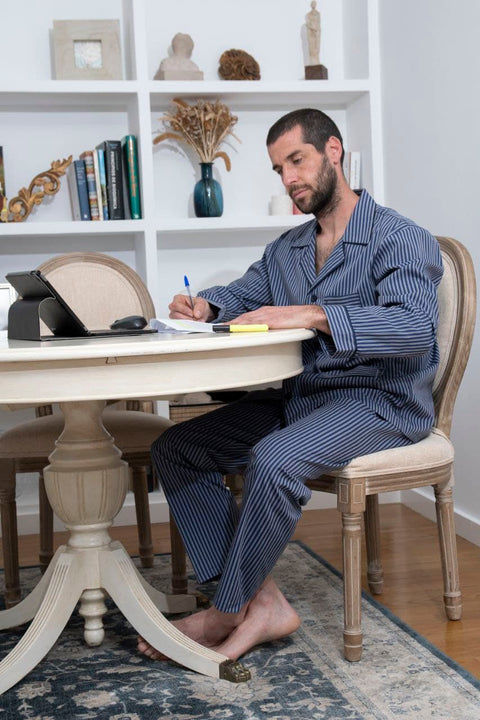
Some claim that the best remedy for mental, physical, and emotional health is sleep. Those who sleep late are labeled as lazy and sluggish. The best companion for these hours, which should be sacred, should always be the pajamas. But why is this stigma not good, and what effects does sleep have on daily life?
At first glance, the topic of sleep does not seem particularly fascinating. Especially when there are no serious problems with it. It only becomes interesting when it is discovered that to this day, it is not really known why one must sleep for certain mandatory periods.
Humans are the only species that deliberately allows themselves to sleep little because they believe it is not “that necessary” and it is a topic that should not be given much importance. By nature, humans are ambitious, plan a lot every day, and when they need more time, it is at the expense of sleep, and irresponsibly, they commit a recklessness. It is a topic that should be approached with greater seriousness. The use of pajamas is an element to be considered to encourage sleep.
Need and Quality of Sleep
On average, different amounts of sleep are needed depending on age. A newborn baby sleeps between 14 and 20 hours, while adults can manage between 7 and 9 hours. However, each person has a different need for sleep. The quality and quantity of sleep also decrease with age and with the absence of certain environmental elements necessary to achieve it; among others are the right temperature, the condition of the mattress, and of course, the use of appropriate pajamas for the occasion.
Some are night owls, others are early risers. People who get up early generally go to bed early; while night owls like to sleep more and really get going at night. You cannot choose which type you are; it is an innate condition that comes with each person. It is probably even hereditary, that condition of being a night owl. But what you can choose is to be warm and comfortable with your favorite and appropriate pajamas.
These so-called chronotypes follow a certain rhythm of wakefulness and sleep. Experts explain that you can only be vulnerable for a few hours each night. While night owls are still active, early risers are already sleeping, and when early risers are awake very early, night owls are still resting. A clever evolutionary trick.
Tips for Sleeping Better at Night
-
The Key is Regularity
You should try to sleep and wake up at the same time, even on weekends. This way, the internal clock, known as the circadian rhythm, will adjust to what is needed to dive into the phases of deep sleep. For those who have the habit, especially on weekends, of staying up late at night and “sleeping in” in the morning, this is basically just a self-imposed social jet lag. This should be stopped for the good of the body and brain, or at least avoid living with or adopting this bad habit.
-
Catching Up on Sleep: A Myth
You should avoid sleeping very little as much as possible because lost sleep cannot be recovered. Why is this so bad? Because usually, the absence of sleep is not even noticed until suddenly, the person affected by this practice falls asleep for 1-2 hours. As a result, there is a risk of various types of accidents (for example, while driving: microsleep), which often cost lives. It is impressive that having had a sleep deficiency for an average of 19 hours produces the same reaction conditions as a person under the influence of alcohol. In this regard, it is important once again to mention the use of pajamas. They are a huge aid in falling asleep.
-
Light Tells the Body It’s Daytime
Who isn’t happy when the sun shines in the morning? Except maybe teenagers when it shines directly on their bed. Morning sunlight tells the brain that it is daytime again and that now you have to be awake and alert, and you should put the pajamas aside to get ready for daily activities. Therefore, try to absorb as much direct sunlight as possible in the morning.
-
Artificial Light Is Not a Substitute
Artificial light is weaker than natural light and therefore is not as effective in acting as an alarm clock. That’s why you can feel tired and exhausted, even just in the morning. At night, turning on lights, watching TV, using computers or other devices signals the brain that it is still daytime. Very little melatonin is released, a hormone that controls the wake-sleep rhythm. Melatonin produces tiredness, allows you to sleep well, and subsequently sleep well all night and get restorative rest, in collaboration with the use of your preferred pajamas.
-
What Can You Do?
In the late afternoon hours, ready to dim the natural light of the day, take advantage and start preparing your body to rest; put on your pajamas and don’t spend much time watching TV. Likewise, it’s better if laptops and phones are not used during this rest period.
Basically, it is recommended to put on pajamas 1 or 2 hours before going to bed and at the same time avoid being connected to any screen, because the brain lacks the signal of darkness. As a result, brains do not secrete enough melatonin to fall asleep or sleep deeply enough to enjoy all the health benefits.
-
Traumas Are Processed Better During Sleep.
The brain only removes tau and ß-amyloid proteins during deep sleep phases, which have been shown to be associated with dementia. What has been learned is consolidated better and more effectively through sleep. The best ideas and the most creative solutions to problems that seemed unsolvable come while sleeping.
-
Good for the Body
Recovery and regeneration happen best during sleep. Sleeping a lot promotes faster healing in case of illness or injury, and if it’s with the use of good pajamas, even better. While sleeping, motor skills are learned and automated more quickly. Sleep helps you get in shape faster and perform well, like in top-level sports.
From a very young age, it is important to get used to sleeping well and wearing pajamas. It is widely proven that this practice is beneficial for overall body health and mental health. At El Búho Nocturno, we can help in the process of choosing the ideal pajamas.